Showing posts with label artisans. Show all posts

Wednesday, 11 December 2013

Gift Edit: Get Inspired for Christmas

Get Inspired for Christmas

The Christmas lights are on and the streets are crowded... the holiday season is underway and we have loads of special gifts for you!


A Gift Hamper with a twist...

This season we have launched our 'Gift Hampers with a Difference.'  Each piece has a story and has a use which will create a special, thoughtful gift or a focal point in your home.  The idea--you choose the cushions and the basket that you like and we will gift wrap and ship your hamper for free!  

You can choose from our wax print cushions with beautiful velvet backs or our luxurious woven kente cushions handcrafted by artisans in Bonwire, Ghana.

...and the best part...there is a 10% discount off of the regular retail price using the code below.

Enter GIFT10 to redeem your discount for the gift basket.


Handbag Envy

This Christmas we also have our full range of luxury leathers, raffia totes and wax print handbags to suit every occasion.  Our satchels are big enough to carry a laptop and A4 books while our raffia tote will serve as a chic shopper.

They are all beautiful and  individual...just like you!

Friday, 4 October 2013

Keeping you up-to-date with the Mefie Newsletter and our new Leather Range!

Hello Folks!  As always we are trying to keep in touch and we have launched a newsletter which we wanted to share...so check it out below!
Welcome to our new newsletter!
Thank you for following the journey and evolution of Mefie.  It has been an amazing year thus far and we wanted to have the opportunity to share stories about our travels, our makers and us! In this first edition learn about our new leather range and find out a little more about our woven kente cushions.
Enjoy!
Introducing the Mefie Leather Range


In September, we at Mefie debuted our new leather line at The London Design Festival.  Continuing our tradition of mixing prints, we have designed our satchel, shoulder bag and orange clutch using our signature mixed print motif.  Each bag combines a digital print imposed onto a hard-wearing fabric then mixed with top grain leathers.  Our plum clutch bag is another unique piece where we have combined suede with a traditional tie and dye from Ghana.
In honour of our new range and newsletter, we are offering our customers a 10% discount (ENTER LEA01 at the checkout) on any leather handbag pre-ordered before the 15th of October. The full range will be available to purchase by October 30th both on our website and to view at Portobello Road Market and Alexandra Palace...so get yours before they go!!!

Kente, Kente Kente!
At the beginning of the year Mefie introduced a line of handwoven cushions using the traditional Ghanaian weave Kente. Our customers loved the vibrant colours and intricate designs featured in our kente cushions.  Since then, we have continued to introduce more designs to the line and so we wanted to share it with you.
Kente, and the weaving tradition in West Africa, can be traced back to ancient civilizations as far back as 300 AD.  Legend has it that a man named Ota Karaban and his friend Kwaku Ameyaw from  Bonwire (the leading Kente weaving center in Ashanti), learned the art of weaving by observing a spider weaving its web. After watching the spider, they wove a strip of raffia fabric and later improved upon their skill. They reported their discovery to their chief, who reported it to the Asantehene (The Ashanti King) at that time. The king adopted it as a royal cloth and encouraged its development as a cloth of prestige and hence kente was born.* 
Our handwoven cushions are  the epitome of luxury and craftsmanship.  Each cushion is hand-woven in this traditional weave originally made for royalty in Ghana.  Kente is available in a single, double or triple weave.  Each double weave kente cushion combines two patterns woven on a strip loom while our triple weave cushions combine 3 or more patterns and colours to create a beautiful design.  Triple weave kente is created on a strip loom using mainly silk threads while double weaves combine silk and cotton.
At Mefie we work with weavers in Bonwire, Ghana who spend up to three months to skilfully create each cloth.  Check out our kente cushions made for kings, queens and you!

*The History of Weaving Kente Cloth, http://kente.midwesttradegroup.com/


...And Finally Our Director's Thoughts
Since introducing the kente cushions, many have asked why Kente and so I thought I would share my kente journey.  Although Kente originated in the Ashanti region of Ghana, variations of the weave are also seen in neighbouring countries.  Kente remains the most famous African weave and is known worldwide for its vibrant colours and designs.
I grew up in Canada in the '80's, where I saw kente on beautiful women around me, and on TV...especially when watching the Cosby show (an '80's staple).  Hence, I was aware of the significance of kente from an early age.  During my first trip to Ghana, I was so excited to go to the home of Kente but upon my arrival I was saddened to see that the area famed for its beautiful fabric remains largely undeveloped and weavers work hard to attract buyers.  Hence, in using kente, I wanted to find a way to celebrate the beauty of the weave and to share it with as many people as possible...hence the kente cushion was born! My goal is to ensure that all people have the opportunity to appreciate the works.  Cushions will be admired in your home everyday and with a cushion as special as a kente cushion it will have pride of place in any room.

Mefie is on the Move!  We are back in Ghana for October so look out for our next newsletter with interviews and more!
...And tell a friend to tell a friend...we are new and need you to spread the word!!!

Friday, 1 March 2013

The Hands of Kumasi Central Market

This week I spent a great deal of time in Kumasi Central Market, hence, I wanted to give you a peek into the hustle and bustle of this vast place.  The market was built in 1936 and since it has continued to grow and grow and grow.  It is the largest open-air market in West Africa with over 10,000 stalls and attracts traders from all over Kumasi and surrounding areas.  I have had the opportunity to spend the week in the market and, as always, I was mesmerized by its ebb and flow.  Everyone has their own destination as they walk down the narrow alleyways, yet somehow they work together to keep the market running.

Although I have always been a lover of shopping and I have out-walked most of my family and friends on my quests to find the perfect outfit or original piece-- I have to say that Kumasi market ALMOST defeated me with its vast size.  The thing I love about this market is the grittiness of it --there is no pretense or window-dressing just the goods that stand on their own and so it really strips the retail experience down to the bare essentials of trade without pressure to consume more than is actually needed or intended for that day.   Maybe it is just my experience, but the market is too big and busy to stroll through, so you have to go with a purpose and in order not to get trampled you have to continue to walk with a purpose....no stopping unless you need it. Hence, it limits the constant consumption of goods that plagues us in the 'West'.

...So why the title you may ask?  Well, my mother has always said that 'you can tell how hard someone works by how hard or soft their hands are' (yes I know this precludes all white collar workers but the analogy works in this case) and so I thought that concentrating on the hands of those that are working in the market was very befitting....I cannot attest to whether the hands of the people that I met were hard but I do know that they were busy at work in the HOT Ghana sun and rain or shine they made it work.

The market truly is the lifeblood of the retail sector for Kumasi and the surrounding villages.  If there is any chance that you are going to be able to buy something it will be in the market as it is VAST.  There is an area of men making shoes, clothes, handbags, sewing kente.  There are copious amounts of ingredients freshly prepared and waiting to be consumed, housewares, hairdressing shops, fabric shops etc etc etc.  All are neatly organized into sections where one can go from stall to stall to find exactly what you are searching for.  Adding to the vast number of shops are food and water sellers and stock-people who continuously walk down the winding paths to deliver goods from one place to the next.

As is the case in many other societies and is similar here--there are the owners and there are the workers and I would not be remiss to say that the owners do not have it as hard as the workers.  Those who work for the owners tend to be those from the vastly poorer North of Ghana.  They range from very young girls to older men and rain or shine you will see them working.  For the workers...there is no other way to say it but it is a TOUGH existence--nothing close to anything that my soft hands have encountered.  I consider myself quite a hard worker by Western standards and yet still, I can say, hand on heart, that I don't think that I could do this work but I do have the utmost respect for those that do.

In starting mefieuk I hope to be able to bring about growth in some way and the market embodies the reason why I hope to bring about a little bit of change.  At the moment, there are so many that are working so hard and yet it is evident that they continue to live below the poverty line.  Hopefully with time, and growth our company can continue to work with the artisans and craftsman that are here and up-skill the labour force and ultimately improve peoples livelihoods.

So as always, I am leaving you with some pictures of the hand and people at work.

Enjoy
xx mefieuk


Garment making at its best!


Kente sewing...fist the pieces then the garments


Beautiful Embroidery done from memory 


The shoe making process in the market ...


The great braid and weave experts


A new meaning to the working mom...braiding with the babies in tow


Food food and more food....this is dried fish--it is actually very tasty!


Thursday, 21 February 2013

Kente - The Bonwire Story

So it has been some time since I have posted a substantial post but with preparations to go to Ghana time has been limited...alas, I am in Ghana and so the adventures have begun!  In my first post from this beautiful country, I have had the opportunity to explore the creation of Kente.  I have been using Kente in my designs since the beginning of mefie.co.uk and there has definitely been a great response to the print.  The intention while I are here is to expand its use re-purposing it in new and exciting ways.  Initially, I had gone to the hub of the Ghanaian retail sector and carefully selected fabrics from the markets but on this trip I wanted to explore where this great traditional weave originates.  It would be a shame not to really explore kente and understand not only where it comes from but what it means.

Kente cloth originated in the Ashanti kingdom and was traditionally worn by the kings.  Even today there are special weaves which are only worn by royalty.  Over time its use has become more widespread although it is still traditionally worn and used for special occasions.  The cloth is woven in strips and each of the woven patterns has a meaning.  As one of the weavers explained yesterday ' they don't just weave for beauty but to communicate a meaning.' Hence, each of the cloths is special and unique in its own right.

So yesterday, I had the opportunity to travel to the main area in the Ashanti region where Kente cloth is produced, Bonwire. The town is only about 40 minutes outside of Kumasi and upon my approach I was surprised by how small and remote the township is.  As many of you may know, Kente is one of, if not THE most famous woven African cloth so I had imagined a large building to house all of the kente weavers.  I can remember watching The Cosby Show in the '80s and seeing Cliff and Claire in various Kente throws so my imagination ran wild.  Instead as we left Kumasi, we were met with two inconspicuous signs which directed us to a small building behind some houses where kente is made. 

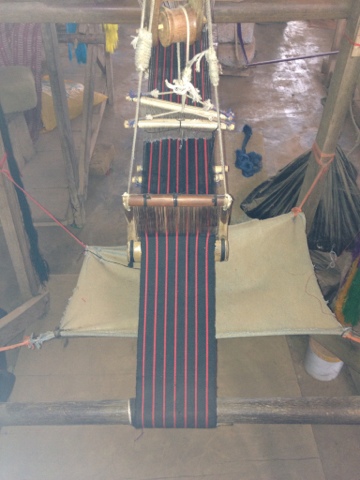
After greeting the weavers outside of the building, I entered into a room where I was met with a variety of beautiful weaves as well as various weaving benches.  The craft is dominated by men who create the beautiful patterns.  One weaver explained that although newer designs have been created, many have also been passed down through generations over time.  The price for the kente varies depending on the different type of cloth created (ie. there are single, double and triple weaves), and the intricacy of the designs. I was really surprised to find out that a weave can take anywhere from 6 weeks to 6 months to complete depending on the difficulty.

I also had the opportunity to try to weave and I have to say that if I were to weave for a day I would not have to hit the gym for a while as the process of pulling on the strings with your feet in order to change the direction of the weave while passing the spools of thread through the apparatus is a workout.  After about 5 minutes of weaving my thighs began to feel the burn...and as an avid spinner and Insanity convert I was surprised by the physical labour involved. 

Overall, my trip to Bonwire was an eye-opening experience.  It was great to see how this beautiful cloth has come into existence but sad to know that despite the great popularity and fame of the cloth this area still remains quite underdeveloped.  I will be going back to Bonwire over the next few weeks and hope to have the opportunity to develop a longer terms relationship with the weavers in the area.

I hope you enjoy the journey

xx mefieuk